How to Choose Yarn for Your First Crochet Project
Yarn weights, fibers, and labels explained for beginners - what to buy for your first project and the two mistakes that make learning harder than it needs to be.

Yarn is where crochet gets tempting – all those colors and textures – and also where beginners quietly sabotage themselves by buying the wrong thing. The fuzzy, fancy, or ultra-fine yarns that look gorgeous on the shelf are the hardest to learn on. Here’s how to choose yarn that makes learning easier, not harder.
Jump to section
It’s an easy trap to fall into, because yarn shopping is genuinely fun and the prettiest skein on the shelf rarely comes with a warning label. Beginners often pick by color or texture alone, the same way you’d pick a scarf to wear, without realizing that the yarn itself can make or break how quickly you learn. A gorgeous mohair or a deep charcoal cotton isn’t a bad yarn – it’s just a bad first yarn, because it hides exactly the thing you most need to see right now: your own stitches.
Getting this choice right changes how your first few sessions actually feel. The right yarn lets you watch each loop form, see a mistake the moment it happens, and correct it before it’s buried under twenty more rows. A good outcome isn’t a fancy finished object – it’s yarn that stays out of your way while your hands are still learning what they’re doing.
Understand yarn weight
“Weight” doesn’t mean how heavy the ball is – it means how thick the strand is. There’s a standard scale from 0 (lace, very thin) up to 7 (jumbo, very thick). The names you’ll see most are:
- Fingering / sock (#1-2) – thin; slow going for beginners
- DK / light (#3) – medium-light; nice but a little fine to start
- Worsted / medium / aran (#4) – the beginner‘s best friend
- Bulky and super bulky (#5-6) – thick and fast, great for quick confidence
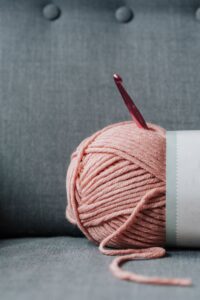
For a first project, choose worsted weight (#4). It’s thick enough to see your stitches clearly, works up at a satisfying pace, and pairs with the common 5.0-5.5 mm beginner hook.
Pick a forgiving fiber
- Smooth acrylic – the ideal learner’s yarn. It’s inexpensive, comes in every color, is machine washable, and has enough “give” to forgive uneven tension. Buy this first.
- Cotton – great for dishcloths and anything that needs to be absorbent or hold a crisp shape. It has less stretch, so it’s a slightly stricter teacher, but very usable.
- Wool – warm and lovely to work with, though pricier and sometimes itchy or hand-wash only. A nice second yarn once you’re comfortable.
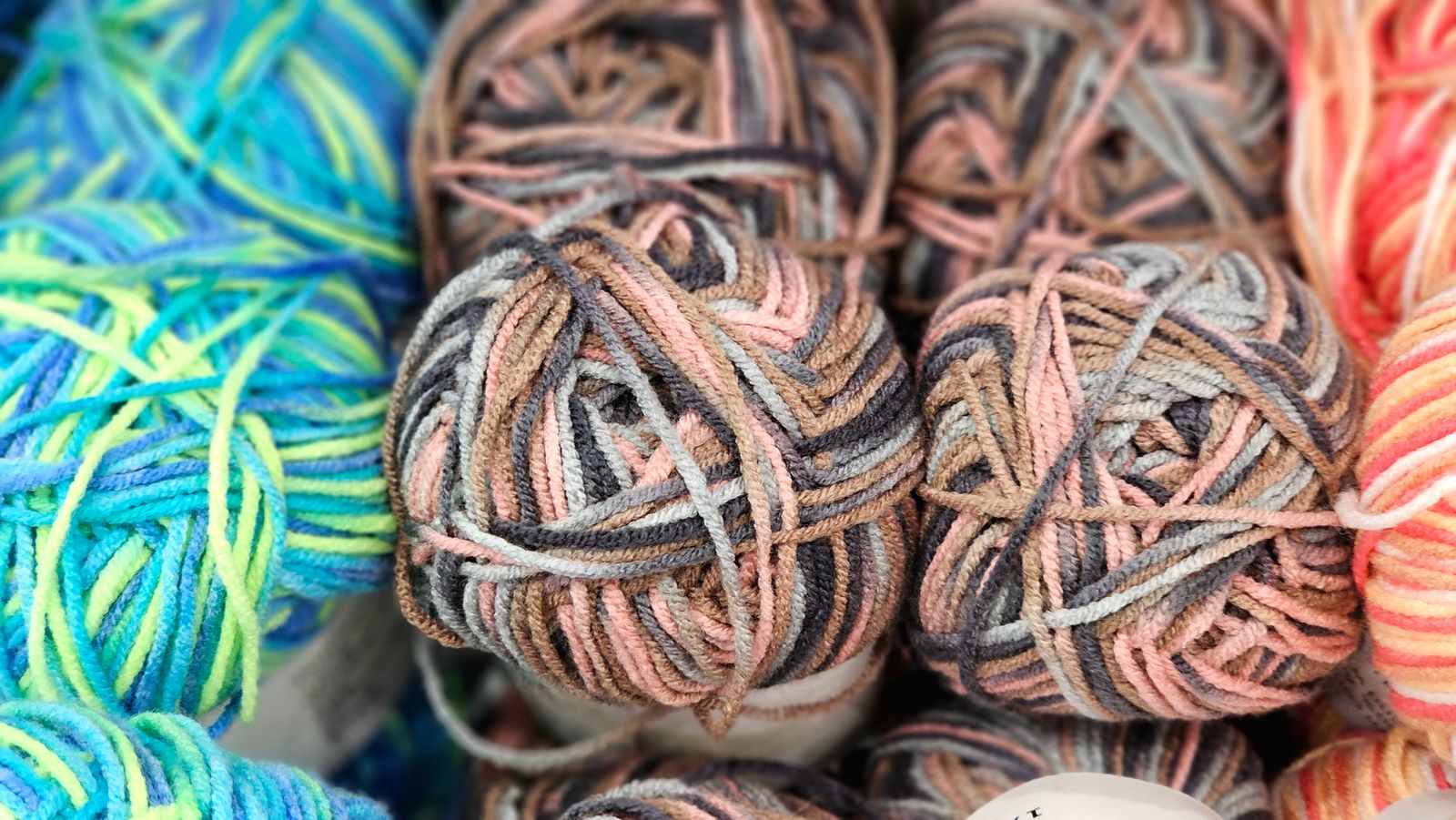
Whatever the fiber, choose a light, solid color to learn on. Stitches are far easier to see and count in cream, gray, or a soft pastel than in black or a busy variegated yarn.
The two yarns to avoid at first
How to read a yarn label
The band around the ball tells you almost everything: the weight category (often with a little hook-and-number symbol), the recommended hook size, the fiber content, the yardage, and the washing instructions.
How much to buy
For a small first project like a dishcloth or a practice square, a single ball is plenty. For a scarf, two to three balls; for a baby blanket, plan on several.
Signs a yarn isn’t right for you
Sometimes you won’t know a yarn is wrong until you’ve made a few rows with it, and that’s fine – it’s useful information, not wasted yarn. A few honest warning signs: if you genuinely can’t tell where one stitch ends and the next begins even in good light, the yarn is fighting you, not your skill level. If the strand keeps splitting apart under your hook instead of staying together as one smooth strand, it’s frustrating to work with regardless of how experienced you are. If the yarn has almost no stretch or “give,” small tension differences between your stitches will show up more obviously, which is discouraging early on even though it won’t matter once your tension evens out with practice.
None of these signs mean you did something wrong – they mean that particular skein is better suited to a project further down the road. Set it aside for later and reach for a smooth, light, worsted-weight ball instead; checking your gauge is far easier when you can actually see the stitches you’re measuring.
Frequently asked questions
What yarn should an absolute beginner buy?
A smooth, light-colored, worsted-weight (#4) acrylic. It’s cheap, forgiving, easy to see, and machine washable.
Why does everyone say to avoid dark yarn at first?
Because you learn by seeing your stitches, and dark or fuzzy yarn hides them. A light, solid color removes a whole layer of frustration.
What does dye lot mean and why should I care?
It’s the batch a yarn was dyed in. Two balls of the “same” color from different lots can differ subtly – enough to show in a finished piece – so buy matching lots for one project.
Can I practice on scrap or stash yarn instead of buying new?
Yes, as long as it’s smooth and light-colored – the same rules apply whether the yarn is new or leftover. Save fuzzy or dark stash yarn for later projects, just like you would with new yarn.
Does spending more on yarn make learning easier?
Not really. Price mostly reflects fiber and brand, not how easy a yarn is to learn on. An inexpensive smooth acrylic is often easier to learn with than an expensive fuzzy or dark novelty yarn.

8 responses