How to Double Crochet: A Step-by-Step for Beginners
A beginner-friendly, tested guide to the double crochet stitch: clear numbered steps, the turning chain explained, and how it differs from single crochet.

If you’ve already learned the chain stitch and single crochet, double crochet (abbreviated dc) is a wonderful next stitch to add to your toolkit. It’s taller than single crochet, which means your projects grow much faster, and it shows up in blankets, scarves, sweaters, and granny squares everywhere. I’m Nora, and I still remember how satisfying it felt the first time a double crochet row came together evenly. Let’s get you there too.
Jump to section
Most beginners hit the same snag here: single crochet only ever has two loops on the hook at once, so double crochet’s extra yarn over and third loop can feel like a lot to track at first. That’s the whole difficulty, and it’s purely a counting habit – there’s no new hand motion to learn beyond what you already know from single crochet.
Getting it right looks like a row of tall, even stitches with a slightly open, drapey feel – noticeably different from the dense fabric of single crochet. If your first few stitches come out different heights, that’s completely normal; consistency is the thing that develops over a row or two, not a single stitch.
What you’ll need
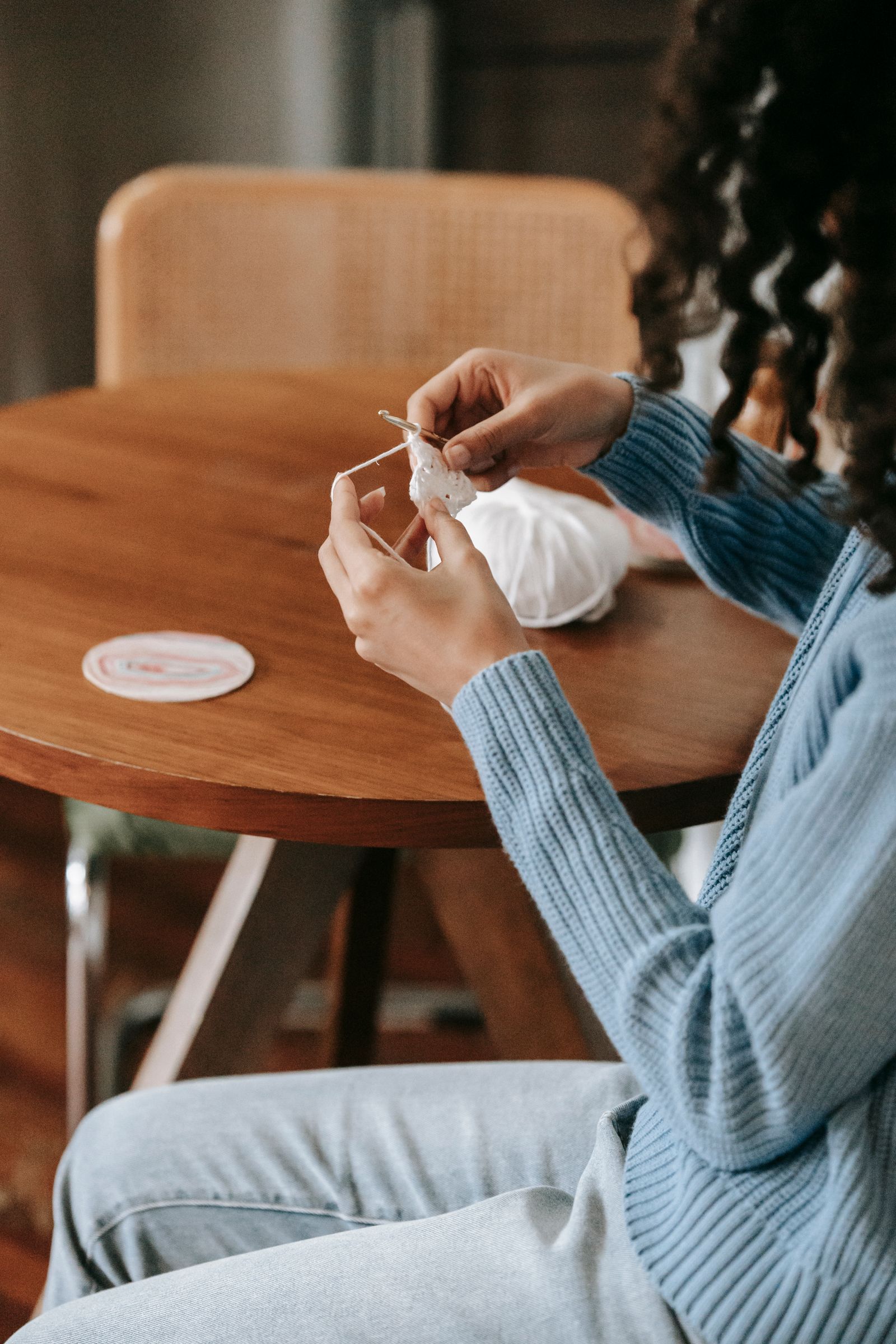
- A smooth worsted weight (#4) yarn in a light color, so you can see your stitches clearly
- A 5.5mm (US I-9) crochet hook
- Scissors
- A yarn needle (for weaving in ends later)
A few quick terms
Before we start, here are the abbreviations we’ll use: yo means “yarn over” (wrap the yarn over your hook from back to front), ch means chain, st means stitch, and dc means double crochet.
Make a practice chain
Chain 16. This gives you a comfortable row to practice on. We won’t count this as a “step” toward the stitch itself — think of it as your starting line.
How to make a double crochet, step by step
- Yarn over first. Wrap your yarn over the hook from back to front. This is the detail that makes a double crochet different from a single crochet, so don’t skip it.
- Insert your hook into the stitch. For your practice chain, skip the first 3 chains from your hook and insert the hook into the 4th chain from the hook.
- Yarn over and pull up a loop. You should now have 3 loops sitting on your hook.
- Yarn over again, then pull through the first 2 loops only. You’ll have 2 loops left on your hook.
- Yarn over one more time, then pull through the last 2 loops. That’s it — one loop remains on your hook, and you’ve just made a complete double crochet.
Continue across the row, putting one double crochet into each remaining chain. When you reach the end, you’ve finished your first row.
Starting your next row: the turning chain
To move up to a new row, turn your work and chain 3. This “turning chain” stands in for your first double crochet of the new row, so you’ll skip the first stitch at the base and work your next double crochet into the second stitch instead. At the end of the row, work your last double crochet into the top of the turning chain from the row below.
How double crochet differs from single crochet
A single crochet has you insert the hook, yarn over, and pull up a loop (2 loops on the hook), then yarn over and pull through both loops in one motion. A double crochet adds an extra yarn over before you insert the hook, and it pulls through the loops in two separate motions instead of one. That’s why a double crochet stands roughly twice as tall, and why fabric made in double crochet grows so much faster — it’s also a little more open and drapey.
Practice makes it automatic
Don’t worry if your first few rows look uneven — that’s completely normal and it evens out with practice. Work a few more rows until the motion feels natural before starting a real project. When you’re ready to finish a piece, head over to our guide on how to fasten off and weave in ends.
How to know you’ve got it
You don’t need a finished blanket to know the stitch has clicked. Watch for these signs instead:
- You stop counting loops out loud (or in your head) mid-stitch. Once the yarn-over-pull-two rhythm becomes automatic, your attention shifts to the row as a whole instead of the individual motion.
- Your stitch height looks consistent across a row without measuring. A little variation is fine, but if every stitch is roughly the same tall shape, your tension has settled in.
- You can talk or half-watch something else while working a plain row. That’s a genuine sign of muscle memory, not a lack of focus — it means the four motions no longer need conscious tracking.
Frequently asked questions
Why does my double crochet look twisted?
This usually happens when the first yarn over gets flipped the wrong way. Make sure you’re wrapping the yarn from back to front over the hook.
Can I use a different hook size for double crochet?
Yes — the stitch works the same way regardless of hook size. A 5.5mm hook with worsted weight yarn is simply an easy, beginner-friendly combination.
How do I know if I have the right number of stitches at the end of a row?
Count your stitches, including the turning chain if your pattern says it counts as one. If the number is off, check that you worked into the very last stitch and not into the turning chain twice.
Is double crochet harder to learn than single crochet?
Not harder, just busier – there’s one more yarn over and one more loop to track. If you’re already comfortable with single crochet, most beginners pick up double crochet within a single practice session.
Why do some patterns use double crochet instead of single crochet for the same project?
Mostly for speed and drape. Double crochet fabric grows faster and hangs more loosely, which suits blankets, garments, and anything meant to move rather than stay stiff, like a dishcloth.